In today’s fast-paced digital world, abbreviations and slang terms have become a normal part of communication. If you’ve ever received a text saying “I miss you sm” or seen someone comment “Thank you sm!” online, you may have wondered about the SM meaning in text.
Understanding texting abbreviations is essential because they help people communicate faster and more casually. Among the many internet acronyms used on social media, messaging apps, and online forums, SM is one of the most common. However, its meaning can vary depending on the context.
This guide will explain everything you need to know about SM meaning in text, including its definitions, examples, alternative meanings, common uses, and frequently asked questions.
What Does SM Mean in Text?
The most common SM meaning in text is:
SM = So Much
People use it to emphasize feelings, appreciation, excitement, or intensity.
Examples:
- “I love this song sm!”
- “Thank you sm for your help.”
- “I miss you sm.”
- “That movie was sm better than I expected.”
In these examples, SM simply replaces the phrase “so much” to save time while texting.
Why Is SM Popular in Texting?
Text messaging and social media encourage quick communication. Users often shorten words and phrases to type faster.
Some reasons why SM became popular include:
- Saves typing time
- Common on social media platforms
- Easy to understand
- Works in casual conversations
- Fits character limits on some platforms
As texting culture evolved, abbreviations like SM became widely accepted among younger users and internet communities.
SM Meaning on Social Media
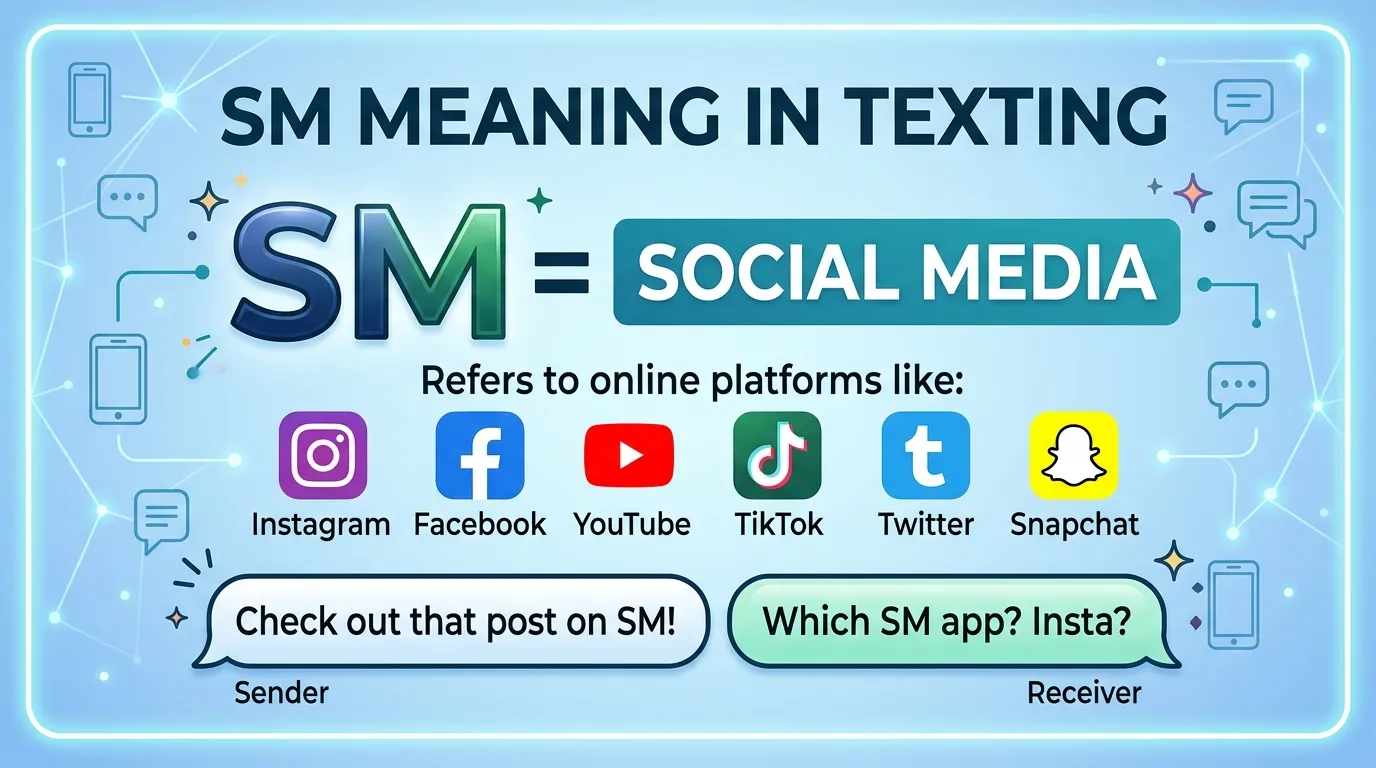
On platforms like Instagram, TikTok, Snapchat, X (formerly Twitter), and Facebook, SM almost always means “so much.”
Common Social Media Examples
- “I love this outfit sm!”
- “Thanks sm for the support.”
TikTok
- “This trend makes me laugh sm.”
- “I needed this video sm today.”
Snapchat
- “Miss you sm!”
- “Love you sm ❤️”
Twitter/X
- “I relate to this sm.”
- “This made my day sm.”
In social media conversations, the abbreviation helps users express emotions quickly.
Different Meanings of SM in Text
Although “so much” is the most popular definition, SM can have other meanings depending on the context.
| SM Meaning | Context |
|---|---|
| So Much | Texting, social media |
| Social Media | Marketing and business |
| Small | Product descriptions |
| Sad Mood | Informal online conversations |
| Service Mark | Business and trademarks |
| Send Me | Casual messaging (rare) |
The surrounding conversation usually makes the intended meaning obvious.
SM Meaning as “So Much”
This is by far the most common usage.
Examples
- “Thank you sm!”
- “I appreciate it sm.”
- “I love you sm.”
- “You helped me sm today.”
Why People Use It
Instead of typing:
“Thank you so much.”
People simply write:
“Thank you sm.”
The meaning remains exactly the same.
SM Meaning in Relationships and Dating Texts
If someone sends:
- “Miss you sm”
- “Love you sm”
- “Need you sm”
They typically mean “so much.”
Examples
Text:
“I miss you sm ❤️”
Meaning:
“I miss you so much.”
Text:
“Love you sm.”
Meaning:
“Love you so much.”
In romantic conversations, SM often expresses affection and emotional intensity.
SM Meaning Among Friends
Friends frequently use SM when chatting online.
Examples
- “Thanks sm for being there.”
- “I laughed sm at your joke.”
- “I appreciate you sm.”
- “You’re the best sm.”
The abbreviation helps keep conversations casual and friendly.
SM Meaning in Gaming Chats
Gamers often use abbreviations to communicate quickly.
In gaming communities, SM may mean:
So Much
Example:
- “That boss fight was sm harder than expected.”
Other Game-Specific Meanings
Certain games may use SM differently, such as:
- Skill Master
- Special Move
- Server Maintenance
Always consider the gaming context before interpreting the abbreviation.
SM Meaning in Business and Marketing
In professional settings, SM often stands for:
Social Media
Examples:
- “Our SM strategy needs improvement.”
- “The SM manager posted new content.”
- “SM marketing is essential for brand growth.”
Here, SM refers to social media, not “so much.”
SM Meaning in Academic and Professional Contexts
Depending on the industry, SM may represent:
Subject Matter
- SM Expert (Subject Matter Expert)
Service Mark
A legal trademark designation for services.
Sales Manager
Used in company structures.
Systems Management
Common in information technology.
Context is key when interpreting abbreviations in professional communication.
Examples of SM in Everyday Text Messages
Here are some realistic examples.
Example 1
Text:
“Thank you sm for helping me move.”
Meaning:
“Thank you so much for helping me move.”
Example 2
Text:
“I miss our conversations sm.”
Meaning:
“I miss our conversations so much.”
Example 3
Text:
“This pizza is sm better than the last one.”
Meaning:
“This pizza is so much better than the last one.”
Example 4
Text:
“I appreciate your support sm.”
Meaning:
“I appreciate your support so much.”
How to Respond When Someone Uses SM
Responding is easy because SM usually means “so much.”
Example Responses
Message:
“Thank you sm!”
Reply:
- “You’re welcome!”
- “Anytime!”
- “Happy to help.”
Message:
“I miss you sm.”
Reply:
- “I miss you too!”
- “Can’t wait to see you.”
- “Thinking about you too.”
Message:
“Love you sm.”
Reply:
- “Love you too.”
- “Love you more!”
- “You’re amazing.”
Common Texting Abbreviations Similar to SM
If you’re learning internet slang, here are other abbreviations you may encounter.
| Abbreviation | Meaning |
|---|---|
| LOL | Laugh Out Loud |
| BRB | Be Right Back |
| IMO | In My Opinion |
| IDK | I Don’t Know |
| TBH | To Be Honest |
| TTYL | Talk To You Later |
| OMG | Oh My God |
| ILY | I Love You |
| TYSM | Thank You So Much |
| SMH | Shaking My Head |
These abbreviations often appear alongside SM in online conversations.
SM vs TYSM
Many people confuse SM with TYSM.
SM
Means:
So Much
Example:
- “I love you sm.”
TYSM
Means:
Thank You So Much
Example:
- “TYSM for your gift!”
TYSM actually includes SM as part of the abbreviation.
SM vs SMH
These abbreviations look similar but have completely different meanings.
SM
- So Much
Example:
- “I appreciate you sm.”
SMH
- Shaking My Head
Example:
- “SMH, I can’t believe that happened.”
Always read the entire abbreviation carefully.
When Should You Use SM?
SM is best used in casual communication.
Good Situations
✅ Text messages
✅ Social media comments
✅ Snapchat chats
✅ Instagram DMs
✅ Messages with friends
✅ Family conversations
Situations to Avoid
❌ Formal business emails
❌ Academic papers
❌ Professional reports
❌ Job applications
❌ Official communications
In professional writing, it’s usually better to write out “so much.”
Benefits of Using SM in Texts
Using SM offers several advantages.
Faster Typing
Typing two letters is quicker than typing two words.
Casual Tone
Makes messages feel friendly and conversational.
Widely Recognized
Most internet users understand the abbreviation.
Saves Space
Helpful on platforms with character limits.
Common Misunderstandings About SM
Misconception 1: SM Always Means Social Media
Not true.
In personal texts, SM usually means so much.
Misconception 2: SM Is Formal English
Incorrect.
SM is internet slang and should generally stay in casual communication.
Misconception 3: Older People Don’t Use SM
While younger users popularized it, many people of all ages now use texting abbreviations.
The Evolution of Texting Slang
Text abbreviations emerged during the early days of SMS messaging when character limits were strict.
Popular shortcuts included:
- LOL
- BRB
- OMG
- IDK
- TY
- SM
As smartphones and social media expanded, these abbreviations became part of everyday online language.
Today, phrases like:
- “Love you sm”
- “Thanks sm”
- “Miss you sm”
are instantly recognizable across many digital platforms.
Related Internet Slang Terms
If you’re researching texting language, you may also encounter:
TY
Thank You
TYSM
Thank You So Much
ILY
I Love You
HMU
Hit Me Up
WYD
What Are You Doing?
FR
For Real
NGL
Not Gonna Lie
FOMO
Fear Of Missing Out
Learning these terms can make online conversations easier to understand.
Is SM Used Worldwide?
Yes. Because English-language social media platforms are used globally, SM meaning in text is recognized in many countries.
People from different regions often use:
- “Thanks sm”
- “Love it sm”
- “Miss you sm”
even when English is not their first language.
This widespread usage has helped make SM a common part of internet culture.
Frequently Asked Questions (FAQs)
1. What does SM mean in text messages?
The most common meaning is “so much.” It is used to emphasize feelings, appreciation, or intensity.
2. What does “I love you sm” mean?
It means:
“I love you so much.”
3. Does SM mean social media?
Sometimes. In business, marketing, and professional discussions, SM often stands for social media.
4. Is SM considered slang?
Yes. SM is a texting abbreviation and part of modern internet slang.
5. Can I use SM in professional emails?
It is generally better to avoid SM in professional communication and write the full phrase instead.
6. What is the difference between SM and TYSM?
SM means “so much,” while TYSM means “thank you so much.”
7. Why do people use SM instead of writing “so much”?
People use it because it is faster to type, saves space, and is widely understood online.
Conclusion
Understanding the SM meaning in text can help you navigate modern digital conversations with confidence. In most cases, SM stands for “so much,” making it a quick and convenient way to express appreciation, affection, excitement, or emphasis. Whether someone says “Thank you sm,” “Love you sm,” or “I miss you sm,” the abbreviation adds emotion while keeping messages short and casual.
However, context always matters. In professional environments, SM can also mean social media, service mark, or other industry-specific terms. When reading messages, pay attention to the surrounding conversation to determine the intended meaning.
As texting, social media, and online communication continue to evolve, abbreviations like SM remain an important part of internet culture. Knowing what they mean helps you communicate more effectively, understand digital trends, and stay connected in today’s fast-moving online world.

I’m a language-focused blogger from the United States, and I write about modern texting habits and online expressions. My goal is to help readers stay up to date with constantly evolving digital slang by sharing accurate meanings, practical usage tips, and real conversational examples.