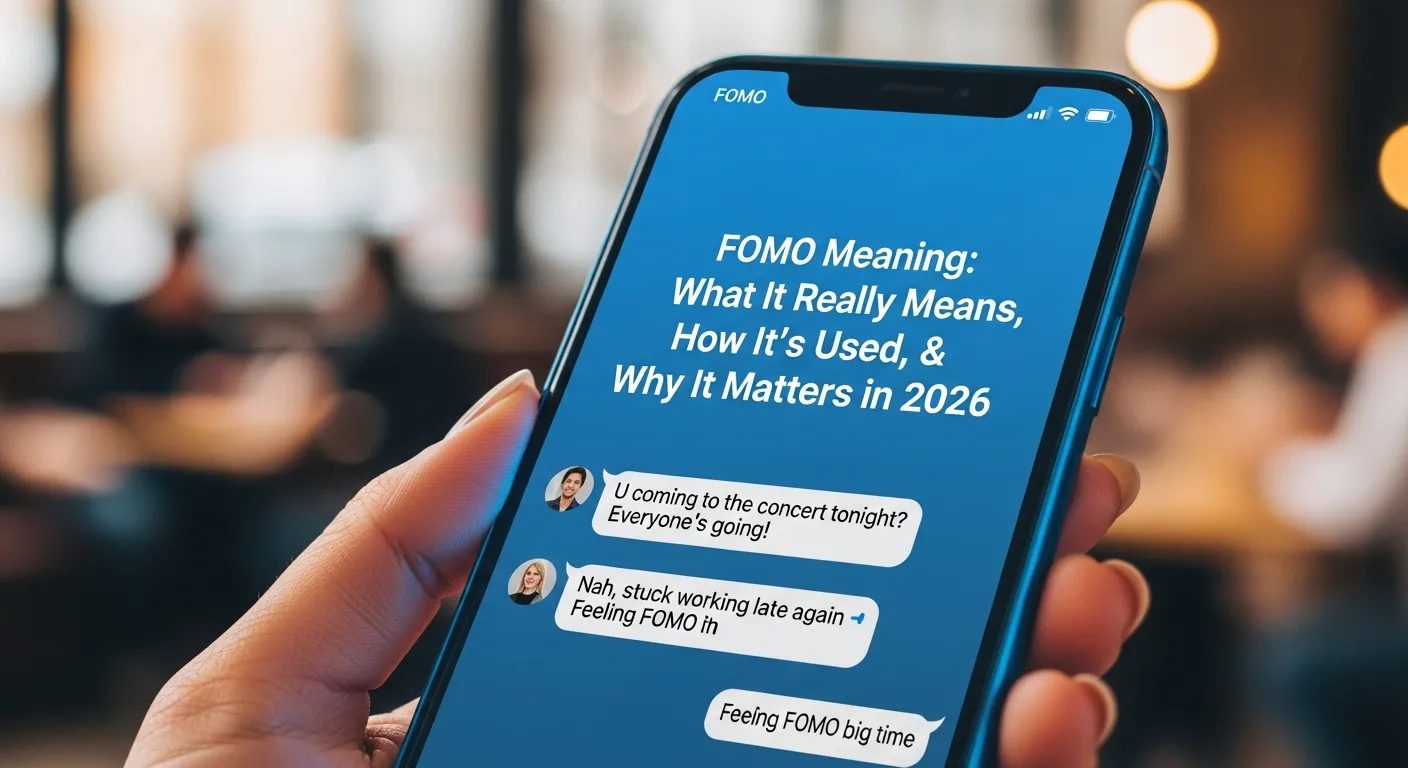
In today’s fast-moving digital world, staying connected has never been easier—and yet, many people feel like they’re constantly missing out. That’s where FOMO comes in. If you’ve ever seen someone text “I’ve got FOMO” or “This is giving me FOMO,” you might have wondered what it truly means.
Understanding the FOMO meaning in text is important because it reflects modern communication, social behavior, and even mental health trends. Whether you’re scrolling social media, chatting with friends, or trying to decode slang, this term pops up everywhere.
In this detailed guide, we’ll break down everything you need to know about FOMO in texting, including its definition, origin, real-life examples, psychological impact, and practical ways to deal with it.
📌 What Does FOMO Mean in Text?
FOMO stands for “Fear of Missing Out.”
In texting and online conversations, it’s used to describe the feeling that others are having fun, experiencing something exciting, or enjoying opportunities that you’re not part of.
👉 Simple Definition:
FOMO (noun): A feeling of anxiety or insecurity caused by the belief that you’re missing out on something better happening elsewhere.
💬 How Is FOMO Used in Text Messages?
FOMO is widely used in casual texting, social media captions, and chats. It’s often used humorously, but it can also express genuine emotions.
🔹 Common Examples:
- “You guys are at the party without me? I’ve got serious FOMO 😭”
- “Seeing your vacation pics is giving me FOMO!”
- “I almost didn’t come, but FOMO made me show up 😂”
- “Don’t post that food pic, it’s giving me FOMO!”
📖 The Origin and Rise of FOMO
The term FOMO started gaining popularity in the early 2000s, especially with the rise of social media platforms like Facebook, Instagram, and later TikTok.
🔍 Key Background Points:
- First widely used in marketing and psychology discussions
- Became mainstream due to social media comparison culture
- Now a standard slang term in texting worldwide
Today, FOMO is not just slang—it’s a recognized psychological phenomenon.
🧠 Why Do People Experience FOMO?
FOMO isn’t just about missing a party—it’s deeply connected to human psychology.
🔹 Common Causes:
- Social comparison: Seeing others’ highlight reels online
- Desire for belonging: Wanting to be included
- Low self-esteem: Feeling like others have better lives
- Overexposure to social media
- Fear of regret
📱 FOMO in the Age of Social Media
Social media platforms amplify FOMO like never before.
🚀 How Social Media Triggers FOMO:
- Constant updates about events, trips, and achievements
- Filtered “perfect” lifestyles
- Real-time stories and live videos
- Viral trends you feel pressured to join
🔸 Example:
You’re at home scrolling your phone and see friends at a concert. Suddenly, you feel left out—that’s FOMO in action.
💡 Different Contexts of FOMO in Text
FOMO can mean slightly different things depending on the situation.
1. Social FOMO
Missing out on parties, hangouts, or gatherings.
- “Everyone’s out tonight and I’m stuck at home 😩 FOMO is real.”
2. Travel FOMO
Seeing others explore new places.
- “Your Dubai trip pics are giving me FOMO!”
3. Event FOMO
Missing concerts, festivals, or special occasions.
- “I didn’t get tickets 😭 FOMO hitting hard.”
4. Digital FOMO
Feeling left out of online trends or viral moments.
- “I don’t even know this trend—FOMO!”
🔄 FOMO vs FOBO vs JOMO
There are similar terms you might see in text conversations.
| Term | Meaning | Explanation |
|---|---|---|
| FOMO | Fear of Missing Out | Anxiety about missing experiences |
| FOBO | Fear of Better Options | Struggling to choose due to better possibilities |
| JOMO | Joy of Missing Out | Feeling happy being alone or offline |
👉 Example:
- FOMO: “I wish I was there!”
- JOMO: “I’m glad I stayed home and relaxed.”
🧾 Real-Life Texting Examples of FOMO
Here are some relatable scenarios where FOMO shows up in texts:
🗨️ Scenario 1: Friends Hanging Out
- Friend: “We’re all at the café!”
- You: “What?! No invite? FOMO 😭”
🗨️ Scenario 2: Social Media Post
- Caption: “Beach day 🌊”
- Comment: “Stop giving me FOMO!”
🗨️ Scenario 3: Work Opportunity
- “Everyone’s attending that seminar except me… FOMO!”
⚠️ The Negative Effects of FOMO
While FOMO can be harmless, it can also affect mental well-being.
❗ Potential Downsides:
- Anxiety and stress
- Decreased self-esteem
- Overuse of social media
- Impulsive decisions (just to avoid missing out)
- Difficulty enjoying the present moment
🌱 Positive Side of FOMO (Yes, It Exists!)
Believe it or not, FOMO isn’t always bad.
✅ Benefits:
- Motivates you to try new experiences
- Encourages social interaction
- Helps you stay informed about trends
- Pushes you out of your comfort zone
🧘 How to Deal with FOMO in Everyday Life
If FOMO is affecting you, there are practical ways to manage it.
💡 Actionable Tips:
- Limit social media time
- Practice gratitude for what you have
- Focus on real-life experiences
- Remember: social media isn’t reality
- Embrace JOMO (Joy of Missing Out)
🗣️ Alternative Slang Words Similar to FOMO
Here are some related terms you might encounter:
- OMO – Overwhelmed Missing Out
- YOLO – You Only Live Once
- Vibes – Emotional atmosphere
- No cap – No lie / truth
- Main character energy – Feeling like the center of attention
📊 FOMO in Modern Culture (2026 Trends)
In 2026, FOMO has evolved beyond just social media.
🔥 Current Trends:
- FOMO in crypto and investing (“I missed the pump!”)
- FOMO in online courses and self-growth
- FOMO in gaming and digital events
- FOMO in viral challenges
🧠 Psychological Perspective on FOMO
Psychologists link FOMO to:
- Dopamine loops (reward system from notifications)
- Social validation needs
- Evolutionary instincts (humans are social beings)
🧩 Key Insight:
FOMO is less about missing events—and more about fear of being excluded.
❌ Common Misunderstandings About FOMO
Let’s clear up some myths:
🚫 Myth 1: FOMO only affects young people
👉 Truth: People of all ages experience it.
🚫 Myth 2: FOMO is always negative
👉 Truth: It can sometimes motivate growth.
🚫 Myth 3: FOMO only happens online
👉 Truth: It can occur in real-life situations too.
📚 Quick Summary of FOMO Meaning in Text
- FOMO = Fear of Missing Out
- Used in texts to express feeling left out
- Common in social media and casual chats
- Can be both positive and negative
- Closely related to modern digital culture
❓ FAQs About FOMO Meaning in Text
1. What does FOMO mean in texting?
FOMO means “Fear of Missing Out,” describing anxiety about missing experiences others are having.
2. Is FOMO a bad thing?
Not always. It can motivate you, but too much FOMO can cause stress and anxiety.
3. How do you use FOMO in a sentence?
Example: “Seeing your party pics gave me FOMO!”
4. What is the opposite of FOMO?
The opposite is JOMO (Joy of Missing Out)—enjoying your own time without worrying.
5. Why is FOMO so common today?
Because of social media, where people constantly share highlights of their lives.
6. Is FOMO a real psychological condition?
It’s not a disorder, but psychologists recognize it as a real emotional experience.
7. How can I stop feeling FOMO?
Limit social media, focus on your life, and practice gratitude.
🏁 Conclusion
The FOMO meaning in text goes far beyond a simple slang term—it reflects how people think, feel, and interact in a hyper-connected world. Whether it’s a missed party, a trending video, or a life opportunity, FOMO reminds us how deeply we value connection and inclusion.
✨ Key Takeaways:
- FOMO is a natural but manageable feeling
- It’s heavily influenced by social media
- Awareness is the first step to controlling it
- Balancing FOMO with JOMO leads to healthier living
👉 Final Tip:
Next time you feel FOMO, pause and ask yourself:
“Am I really missing out—or just comparing?”
Sometimes, the best moments aren’t the ones you see online—they’re the ones you’re living right now.

I’m a content editor and language researcher based in California with a focus on texting terminology, internet slang, and Gen Z communication styles. Through my writing, I help readers understand what popular text phrases mean, how they’re used, and when they fit naturally into casual conversations.